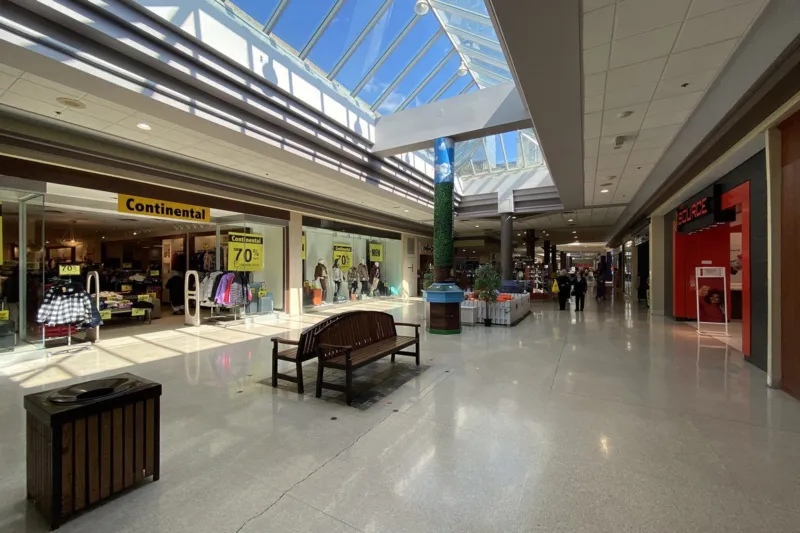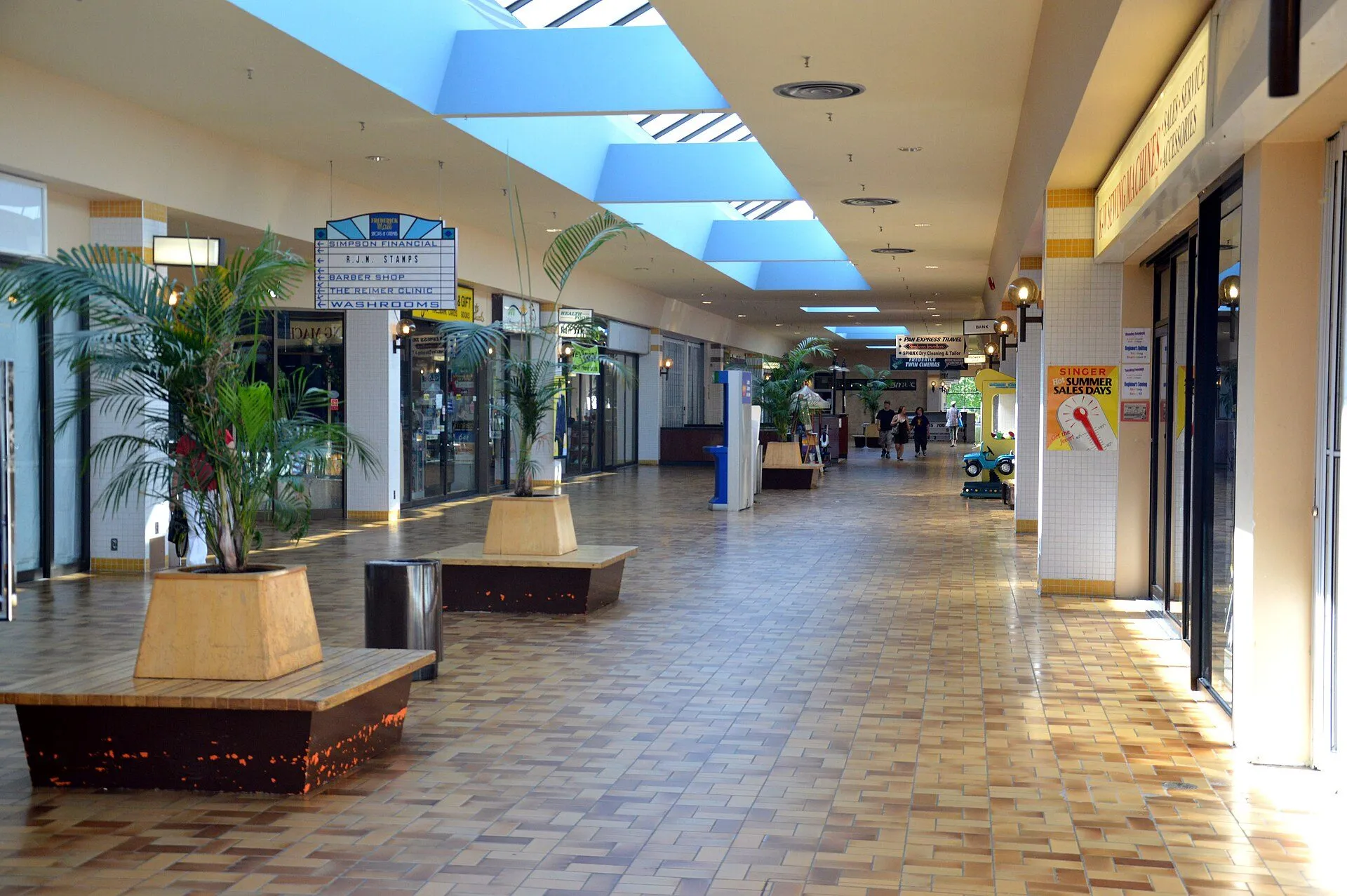
Ask almost anyone who grew up in southern Ontario after the 1960s, and a mall will come up somewhere in their story. Saturdays spent trailing a parent between Eaton's at one end and Simpsons at the other. Winter afternoons under a glass roof. A two-level concourse that felt impossibly big when you were nine.
Some of those malls are busier now than they've ever been. Others are rubble, condo sites or long, quiet corridors. This isn't a list of every mall in the province. It's a handful of the ones that shaped how Ontario shops, and the stories we could actually pin down.
The story
Hamilton goes first
Ontario's mall era began on an old racetrack. In 1952, Toronto businessman E.P. Taylor bought the former Hamilton Jockey Club grounds in the city's east end. In October 1955, by the account of journalist Paul Weinberg, who drew on Hamilton Spectator coverage of the day, about 75,000 people turned up for the opening of The Centre. The Spectator called it Canada's first large regional shopping centre. (A 2018 TVO Today piece dates the opening to 1954; both agree it was the province's first major shopping centre.)
It started out as an open-air plaza. In 1974, it reopened as the fully indoor Centre Mall.
Yorkdale, 1964
Toronto's turn came in February 1964, at Dufferin Street and Highway 401. Yorkdale opened with more than 1.2 million square feet and 61 stores. Eaton's anchored one end, Simpsons the other, and a Dominion grocery store rounded it out.
Eaton's had bought the land back in the 1950s for about $1.4 million, and Seattle's John Graham Consultants designed the complex. When it opened, Yorkdale was billed as the largest enclosed shopping mall in the world. The title didn't last, but the novelty did. Toronto's two great department-store rivals were now under one roof, and you could walk between them without putting your boots on.
The 1970s boom
The next decade filled the map. Fairview Mall opened in North York on Aug. 5, 1970. It was built for about $20 million by the Fairview Corporation, a real estate company owned by four of Samuel Bronfman's children. It had two levels, about 100 stores, and The Bay and Simpsons as anchors. Fairview was Toronto's fourth fully enclosed mall, and parking took up 35 of its 46 acres.
The Galleria followed at Dufferin and Dupont in 1972. Scarborough Town Centre opened in 1973.
That same year, on Oct. 3, 1973, Square One opened in what would become downtown Mississauga. Developer Bruce McLaughlin had started construction in 1969. The $44-million mall had about a million square feet of climate-controlled space on two floors, and it was the largest mall in Canada when it opened. Its anchors were Dominion, The Bay, Simpsons-Sears and Woolco. Its Garden Court had a bandshell, fountains, cinemas and a skating rink in winter. Mississauga's City Hall went up beside it, and the mall became the anchor for a whole new downtown.
Then, on Feb. 10, 1977, the Toronto Eaton Centre opened downtown. Getting it built had been a fight. Early plans called for tearing down Old City Hall and the Church of the Holy Trinity. Public opposition helped delay the project for years, and both buildings survived. What finally opened had Michael Snow's flock of fibreglass Canada geese, Flight Stop, hanging overhead, and an interior that influenced shopping centre design across North America.
The 1980s
Lime Ridge Mall opened in Hamilton in 1981. The old Centre Mall answered in 1983 with 44 new stores and an eight-screen Mall Cinemas seating 2,400.
In 1982, Sarnia got the Sarnia Eaton Centre, built right in the downtown. Fairview, meanwhile, kept reinventing itself: a $90-million renovation from 1987 to 1989 gave it the glass-tiered ceiling many people picture when they think of it.
Why people remember it
Malls weren't just shopping. They were where a suburb went when it needed somewhere to go. Fairview even published its own magazine, starting in 1973. Square One's Garden Court came with music, fountains, movies and skating. As transit caught up, malls became places you could get to on your own: Fairview gained a TTC bus terminal, and in 2002 it got a direct link to Don Mills station on the Sheppard subway line.
They were never invincible, though. Malls rose and fell with their big tenants. As TVO Today has pointed out, Etobicoke's Honeydale Mall and Woodstock's Blandford Square both faded after their Walmart stores moved elsewhere. And the same 2018 piece noted that London's Westmount Mall had been sold, and that part of it had been turned into medical offices.
What happened?
The biggest blow was losing the department stores at the ends of the hallways.
- Eaton's went into bankruptcy protection in 1997 and closed 21 stores. Sarnia's was among the first to go. In August 1999, with 64 stores left, it filed again. Sears Canada bought the name and assets that September and relaunched a smaller "eatons" chain in November 2000, but in February 2002 it announced those stores would close.
- Simpsons had already been bought by the Hudson's Bay Company in 1978.
- Sears Canada announced in October 2017 that it would liquidate its remaining 131 stores. The last ones closed on Jan. 14, 2018. At Fairview, the former Simpsons-turned-Sears space was still sitting empty in 2020.
- Hudson's Bay closed all of its stores on June 1, 2025. More than 8,300 workers were laid off.
Some malls didn't survive at all. In Hamilton, the Centre Mall's stores and theatres closed in the early 2000s. A $100-million "rebirth" was announced in 2006, demolition was announced in 2007, and the mall came down in 2008, according to TVO Today. The site was rebuilt as an outdoor big-box centre, The Centre on Barton.
Sarnia's Eaton Centre, later renamed Bayside, was mostly empty by 2013. The old Eaton's building had been turned into offices for Lambton County social services. Seasons Retirement Communities bought the property in 2017, and most of the mall was demolished in 2021 and 2022.
Toronto's Galleria, which CBC News said kept a distinctly 1970s feel for most of its life, was already slated for redevelopment by 2018. Demolition began in the fall of 2019, and by January 2020 crews were bringing it down.
What's there now?
- Yorkdale is thriving. In 2024, Retail Insider reported more than $2 billion in annual sales, or about $2,402 per square foot. Oxford Properties manages the centre.
- Square One now covers more than two million square feet and is the largest mall in Ontario.
- Fairview Mall added a Cineplex-run Playdium entertainment centre, one of five Playdium locations in Canada by mid-2026.
- The Galleria site is being rebuilt as Galleria on the Park. When demolition began in 2020, ELAD Canada's plans called for eight towers, a revamped park and a new community centre. By August 2026, blogTO reported, the first two towers had been under construction since 2020, work on the park and community centre had started in 2022, and a third tower was under way.
- Hamilton's Centre Mall site is The Centre on Barton, a big-box power centre.
- Sarnia's Bayside site is being redeveloped with a seniors' residence, a long-term care home and a courthouse.
- At Windsor's Devonshire Mall, the former Bay store, which opened as a Simpsons in 1974, is set to be demolished for a new south entrance, according to a July 2026 Retail Insider report.
- At Sherway Gardens, the space Nordstrom used from 2017 to 2023 is set to become a Splitsville bowling and arcade venue in fall 2027.
Quick facts
- Ontario's first major shopping centre: The Centre, Hamilton (opened 1955; some sources say 1954)
- Yorkdale's opening: February 1964, with 61 stores and Eaton's and Simpsons as anchors
- Largest mall in Canada when it opened: Square One, Oct. 3, 1973
- Toronto Eaton Centre's opening: Feb. 10, 1977
- Last Sears Canada stores closed: Jan. 14, 2018
- Last Hudson's Bay stores closed: June 1, 2025