For a generation of Ontario families, the long drive north had built-in rewards: a giant goose, a nickel you could stand beside, a fish taller than a house. These landmarks were built to get you off the highway, and a surprising number of them are still doing that job. Here are the ones we confirmed are still standing, grouped by the highway that brings you to them, plus a few for southern Ontario drivers.
Built for the highway
Several of Ontario's best-known roadside icons are tied directly to the highway. Kenora's muskie went up in 1967, nine years after the Trans-Canada Highway came through town, because local boosters wanted passing travellers to stop. Wawa ties its goose to the finishing of the last stretch of highway along Lake Superior. The idea everywhere was the same: give drivers a reason to hit the brakes.
The best of them are still a little ridiculous, and that's the point. Nobody needs a photo with a giant nickel. Everybody takes one anyway.
Highway 17: Lake Superior and the Northwest
The Wawa Goose — Wawa
Wawa's goose isn't just a statue. It's the town's calling card. The Municipality of Wawa ties it to the completion of the last link of the Lake Superior section of the Trans-Canada Highway, and today it stands beside the Tourist Information Centre on Mission Road. It makes an easy stretch break for drivers heading around the top of the lake. The information centre has free parking, washrooms, Wi-Fi and even a water station for dogs. The Wawa Goose
Winnie the Pooh — White River
Here's a roadside statue with a real story behind it. In 1914, Lieutenant Harry Colebourn bought a black bear cub at the White River train station. He named her after Winnipeg, and she ended up at the London Zoo, where her fans included a boy named Christopher Robin Milne and his father, A.A. Milne. Today a Winnie the Pooh statue stands in a small park just off Highway 17 at the edge of town, with gardens, a playground and the tourist information centre nearby. The township still holds a Winnie's Hometown Festival every year, and the White River Heritage Museum on Elgin Street keeps Winnie artifacts alongside the town's railway history. Winnie the Pooh Park
Max the Moose — Dryden
Max has stood at the Dryden Tourist Information Centre on Government Street since July 19, 1962. Ontario's Sunset Country puts him at 18 feet (about 5.6 metres) tall, and CBC News describes a build of metal frame, mesh and concrete plaster. He isn't the biggest moose in Canada, and Dryden doesn't pretend otherwise. When Moose Jaw and a Norwegian town were sparring over who had the biggest moose statue, Dryden's position, as reported by CBC, was that the bigger moose could fight over second place, because Max got there first. Max the Moose
Bigfoot — Vermilion Bay
Nobody seems sure exactly where Vermilion Bay's Bigfoot came from. Destination Northern Ontario says he stands about 20 feet tall, weighs about three tons and moved to his current spot on Highway 17 in 1982. He's often dressed up in costumes, so you never quite know what he'll be wearing when you drive by. Slow down. You'll want the photo. Vermilion Bay Bigfoot
Husky the Muskie — Kenora
Husky was unveiled on Dominion Day, July 1, 1967. He was a Centennial project of the Kenora District Chamber of Commerce, meant to get travellers on the Trans-Canada, which had come through Kenora in 1958, to stop in town. Built from steel, plywood and fibreglass, he rises about 12 metres over McLeod Park on the harbourfront. According to the Daily Commercial News, the muskie beat out the walleye because it's the trophy fish anglers brag about. Building him took about a ton of steel, 3,500 bolts, plywood and hundreds of square feet of fibreglass, at a cost of roughly $5,000. His name came out of a contest, and the winning entry arrived with a slogan about preventing water pollution. Husky needed a major structural rebuild in 1996 and still stands watch over the harbour. Husky the Muskie
Sudbury and Highway 11
The Big Nickel — Sudbury
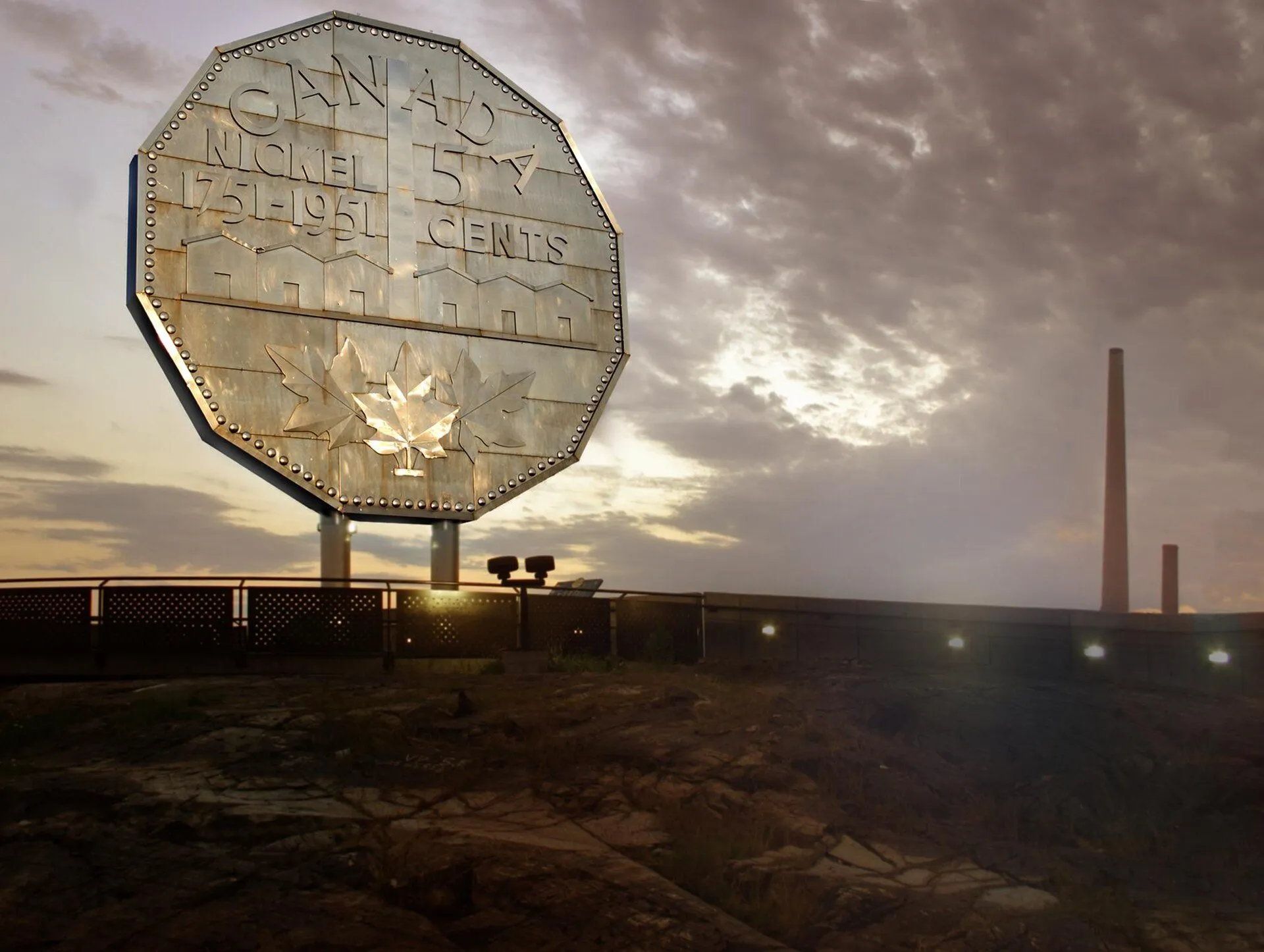
Sudbury's Big Nickel went up in 1964. It's a replica of the 1951 Canadian five-cent piece, with King George VI on one side and a nickel refinery on the other. It weighs about 13,000 kilograms, and Science North likes to point out that it's tens of millions of times the size of the coin in your pocket. Today it stands on Big Nickel Road at Dynamic Earth, Science North's earth sciences centre in Sudbury, and it's still a classic Sudbury photo stop. The Big Nickel at Dynamic Earth
Ms. Claybelt the Cow — New Liskeard
Farm country gets its own giant. Ms. Claybelt is a 12-foot fibreglass Holstein outside the Little Claybelt Homesteaders Museum. Destination Northern Ontario credits her to Jerry Shepherdson of New Liskeard's Mid-Canada Fibreglass, who finished her in the mid-1980s. The same firm is also credited with Moonbeam's flying saucer, so you can make a theme of it. Ms. Claybelt the Cow
The Flying Saucer — Moonbeam
Moonbeam leaned into its name. After reports of UFO sightings in the area in the 1960s and '70s, the town put a replica flying saucer beside Highway 11. It's about 2.7 metres high and 5.5 metres across, with a visitor centre that sells alien souvenirs. It's one of the strangest and most cheerful stops on the northern route. Moonbeam's Flying Saucer
Chimo the Polar Bear — Cochrane
Cochrane has built much of its identity around polar bears, from its Polar Bear Habitat to the Polar Bear Express train, so of course it has a giant one. Destination Northern Ontario says the original Chimo statue debuted in 1970 and stood for nearly 50 years. A new Chimo replaced it in 2018, and the original went to the Polar Bear Habitat to be restored. Chimo the Polar Bear
The Beardmore Snowman — Beardmore
Few roadside giants are dressed for the season, but this one is. Superior Country, the regional tourism agency, says the Beardmore snowman on Highway 11 stands 35 feet (about 10.6 metres) tall and bills him as the world's largest snowman. He keeps his top hat and sunglasses on all year, carries a curling broom in winter and switches to a fishing rod for summer. The Beardmore Snowman
Southern Ontario
Jumbo — St. Thomas
St. Thomas has an elephant because of a real tragedy. On September 15, 1885, Jumbo, the circus star CTV News has called the world's most famous elephant, was struck and killed by an unscheduled freight train in St. Thomas after performing for a crowd of more than 10,000, according to Railway City Tourism. A life-size statue went up on Talbot Street in 1985 to mark the centennial of his death. In July 2025, CTV News called it the city's most famous tourist attraction, as a new exhibit marked 140 years since Jumbo died. Jumbo the Elephant
Muddy the Mudcat — Dunnville
Dunnville's catfish is a proper whopper. Tourism Haldimand describes Muddy as a 50-foot-long, 27-foot-high statue in Centennial Park celebrating the town's fishing heritage. In 2024, the Haldimand Press reported that Muddy was competing in Municipal World's contest to name Canada's greatest landmark. Muddy the Mudcat
The Big Apple — Colborne
The Big Apple sits just off Highway 401 at Colborne. It's still open as a bakery and market, and its website still invites visitors to explore the "apple observatory." There's also mini golf, a petting zoo, train rides and a carousel, plus food trucks, a smokehouse and plenty of apple pie to take home. It's the rare roadside giant that's also a full lunch stop. The Big Apple
Planning a stop
A few tips for the big-statue road trip:
- Pair them up. Dryden, Vermilion Bay and Kenora all sit along Highway 17 in the northwest, and the Wawa Goose and White River's Winnie share the Highway 17 run along Lake Superior.
- Go in season. Some visitor centres beside these landmarks, like White River's, are only open in summer, even though the statues are outdoors all year.
- Check before you detour. Monuments do get moved, repaired or replaced, as Chimo's story shows, so a quick look at the town's tourism page before a long detour is a good idea.
Details checked October 2026. Hours and seasons change — confirm with each business before you go.