If you grew up in Ontario before the 1980s, Eaton's was hard to avoid. It was the catalogue that showed up at farmhouses far from any city. It was the Santa Claus Parade rolling through downtown Toronto in the cold. It was lunch with your grandmother in a ninth-floor dining room, or a whole afternoon wandering a store so big it felt like its own neighbourhood. For a lot of families, "Eaton's" wasn't a store so much as a fixture, like the post office or the church on the corner.
That's why its end, when it came, felt personal. Here's how a dry goods shop on Yonge Street became one of the biggest names in Canadian life, and how it came apart.
The story
Timothy Eaton was an Irish immigrant, born in 1834, who came to Canada from County Antrim in 1854. In 1869 he opened a store at 178 Yonge Street in Toronto.
What made it different was how it sold things. At the time, buying dry goods often meant haggling and running up credit. Eaton's sold for cash only, at one fixed price, so the same bolt of cloth cost the same for everyone. In 1870 it added a promise that became a slogan: "Goods Satisfactory or Money Refunded." It sounds ordinary now. Back then it was a bold way to earn trust.
The business grew fast. In the early 1880s it moved to a larger Yonge Street site, and in 1884 it handed out its first catalogue during the Toronto Industrial Exhibition. That catalogue changed everything. It let families in rural communities order the same goods city shoppers could see in person, and it would keep landing in mailboxes for more than ninety years.
In 1905 Eaton's opened a big store on Portage Avenue in Winnipeg, and the same year it staged the first Eaton's Santa Claus Parade in Toronto, on December 2. Timothy Eaton died in 1907, and his son John Craig Eaton became president. The company kept a reputation for treating staff better than many employers of the day. By 1919 it was giving workers Saturday holidays and closing at 5 p.m., and over the years it added benefits like medical insurance and retirement plans.
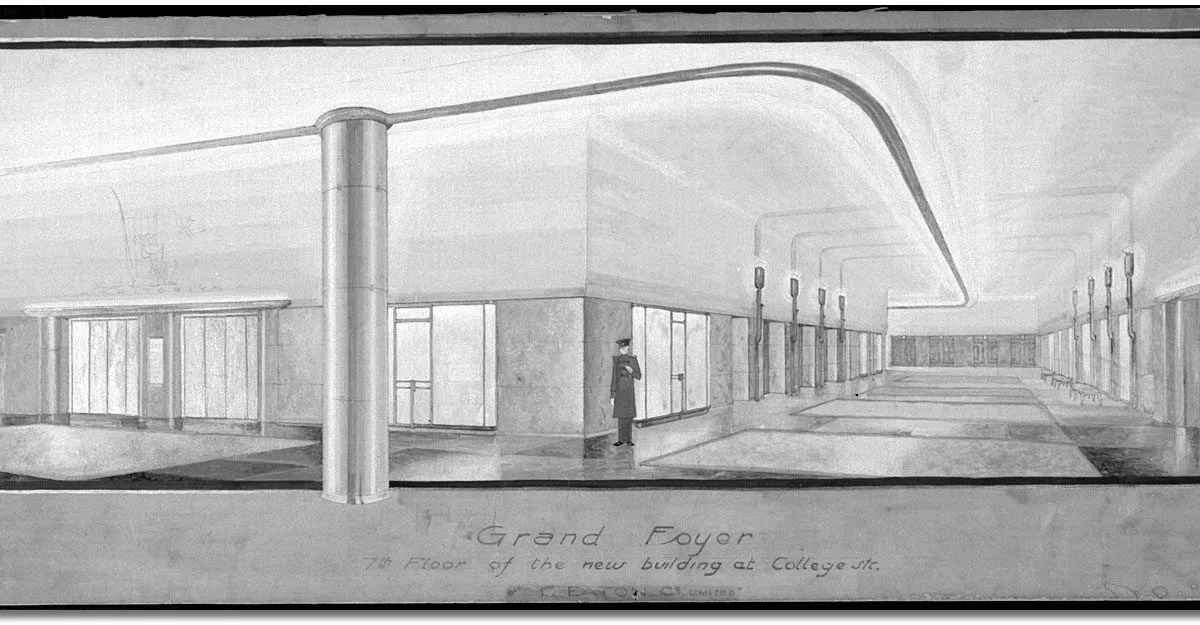
The 1920s and early 1930s were Eaton's high-water mark. In 1924 the Queen Street store opened the Georgian Room, a ninth-floor restaurant Lady Flora McCrea Eaton designed with London's Harrods in mind. In 1930 Eaton's opened a grand new store at College and Yonge. By then the company employed just over 25,000 people and controlled almost 60 per cent of department store sales in Canada. The College Street store's seventh floor, which opened in 1931, held an Art Deco auditorium and the Round Room restaurant, designed by the French architect Jacques Carlu.
Why people remember it
Some of it is the scale. Eaton's wasn't just where you bought a winter coat; it set the tone for what shopping in Canada could be.
But mostly it's the rituals. The catalogue meant something different depending on where you lived. In the city it was a wish book. In the country it could be the store itself. When Eaton's ended the catalogue in 1976, more than 9,000 jobs went with it, and a link between rural Ontario and the big city went quiet.
Then there was the parade. Eaton's ran the Santa Claus Parade for 77 years. When the company announced in August 1982 that it was pulling out, citing costs approaching half a million dollars, a volunteer group calling itself "Save Our Santa" stepped in within a week. The parade carried on as a not-for-profit, which tells you how much Torontonians had come to think of it as theirs rather than the store's.
And there were the dining rooms. The Georgian Room, with its cut crystal chandeliers, served lunches, afternoon teas and dinners for more than fifty years. The Round Room at College Street ranked among the city's premier dining rooms, alongside Simpsons' Arcadian Court and the Royal York. (We dig into both in our story on the department store restaurant.)
It's worth remembering, too, that Eaton's was a big employer and a powerful company. Its story isn't only a warm one. But for shoppers, the name carried a kind of steadiness that few brands ever earn.
What happened?
Eaton's didn't fall all at once. From the 1960s on, Simpsons-Sears and a growing crowd of specialty retailers chipped away at its dominance.
There was also a big change to its home turf. In 1966 Eaton's and Cadillac Fairview announced plans for a huge new shopping complex in downtown Toronto. Phase one of the Eaton Centre opened on February 10, 1977, with a new nine-storey Eaton's store at its north end. The old Queen Street store, Georgian Room and all, was closed and torn down to make room for the mall's southern half, which opened in 1979. The project was a fight in its own right: the design was reworked so that Old City Hall survived intact, and parishioners of the Church of the Holy Trinity won protection for their building and even for the sunlight reaching it. The result was a long glass-roofed galleria that architects Eberhard Zeidler and Bregman + Hamann modelled on Milan's Galleria Vittorio Emanuele II. The Georgian Room served its last meals on Christmas Eve 1976. Around the same time, the College Street store's run came to an end, and the building was sold and renamed College Park.
By the 1990s the company was struggling. A Maclean's report in March 1997 described a business that had lost $120 million before taxes in the previous year on $1.6 billion in revenue, with its share of department store sales down to 11.4 per cent. Eaton's sought creditor protection in early 1997 and warned that somewhere between 10 and 40 stores could close.
The restructuring didn't hold. In August 1999, 130 years after Timothy Eaton opened on Yonge Street, the company went bankrupt. Sears Canada took over what was left and ran a smaller Eaton's with seven stores. On February 18, 2002, Sears announced it was giving up on the name. Its chief executive, Mark Cohen, put the problem bluntly:
The notion that customers see value in a top-drawer, high-priced, somewhat selective assortment is false.
Mark Cohen, quoted in The Globe and Mail
Five of the stores, including downtown Toronto and Ottawa, were to become Sears outlets. The Eaton's name was retired in 2002.
What's there now?
The Eaton's name survives most visibly on the CF Toronto Eaton Centre, still a major downtown Toronto destination.
The big north-end store that Eaton's opened in 1977 has had several lives since. Sears ran it until 2014. Nordstrom moved onto two floors in 2016, and BMO later took the top four floors for offices. Nordstrom left Canada in 2023, and on September 18, 2025, La Maison Simons opened on three levels of the former Nordstrom space, with Eataly opening beneath it that November.
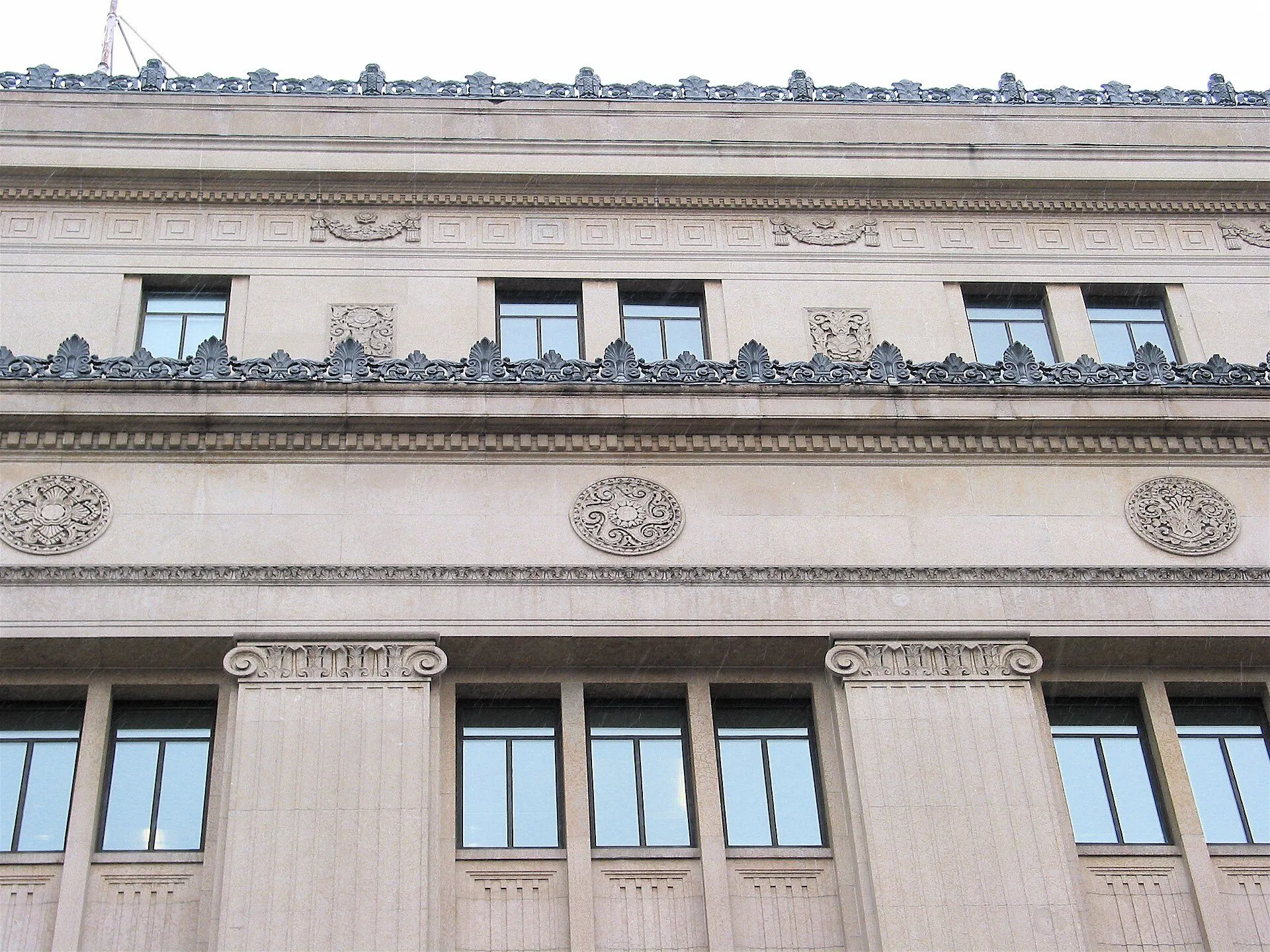
Up at College and Yonge, the old Eaton's College Street store is now College Park, and its seventh floor, designated a National Historic Site in 1983 and restored between 2000 and 2003, operates as The Carlu event venue. Both buildings turn up again in our Then & Now look at Ontario's department store buildings.
Quick facts
- Founded: 1869, at 178 Yonge Street, Toronto
- Founder: Timothy Eaton (1834–1907)
- First catalogue: 1884; ended in 1976
- Santa Claus Parade: first held December 2, 1905; Eaton's withdrew in 1982
- Eaton Centre opened: February 10, 1977
- Bankruptcy: August 1999
- Name retired: 2002, after Sears Canada's takeover