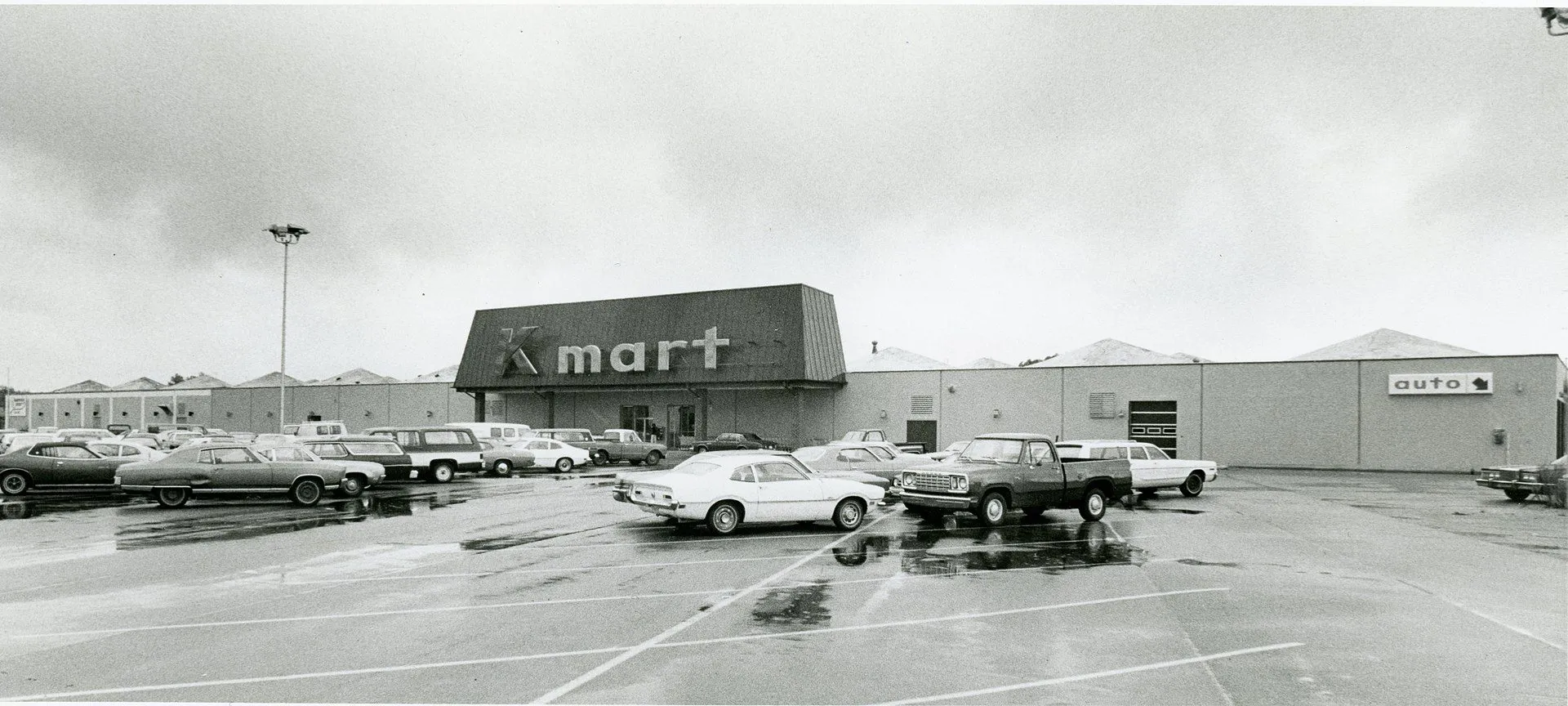
In March 1963, a new kind of store opened at the Huron Heights Shopping Centre on Huron Street in London, Ontario. A London Free Press photo from that month, now held by the London Public Library, shows Kmart arriving with the promise of being "the department store of true values." It was the first Kmart in Canada.
For the next 35 years, Kmart was part of the Ontario retail landscape. Then, in a deal that moved remarkably fast, it was gone.
The story
Kmart's roots go back to S.S. Kresge, the five-and-ten-cent store chain built by Sebastian S. Kresge, who opened his first stores with a partner in 1897. Kresge was in Canada early. According to Kmart's own corporate timeline, its Canadian subsidiary, S.S. Kresge Company, Ltd., was founded in 1929 and had 19 stores running by the end of that year.
On March 1, 1962, Kresge opened the first Kmart discount store in Garden City, Michigan, outside Detroit, and 17 more followed that year. It took just a year for the idea to cross into Canada. After the London opening in March 1963, Retail Insider reports, a Windsor store followed two months later.
The chain grew steadily from there. By 1992, The Christian Science Monitor reported, Kmart Canada had 128 stores and $1.3 billion in sales. That made it a real rival to Zellers, which had about 290 stores at the time.
Why people remember it
Kmart's signature move was the Blue Light Special, a surprise in-store deal, announced on the spot, that lasted only about 15 minutes and was signalled by a flashing blue light. Britannica dates the idea to 1965, and the company's timeline notes it was brought back in 2001 after a ten-year break. It's one of the most famous gimmicks in American retail. We should be honest, though: we couldn't find a reliable Canadian record showing how often Ontario Kmarts ran blue light sales, so if you remember one, we'd love to hear about it.
What's easier to document is how familiar the chain was. Kmart opened in Ontario barely a year after the very first store in Michigan, and it stayed for three and a half decades. By the time it disappeared, Canadian Kmarts had been around long enough for a generation to grow up with them.
What happened?
The 1990s squeezed Canada's discount chains. In January 1994, as Walmart prepared to take over the Woolco stores, The Christian Science Monitor described Canadian retailers bracing for its arrival.
By the end of 1997, Kmart's American parent was getting out of Canada. Retail Insider reports that by December 1997, 112 of Kmart's 122 Canadian stores had been sold to the Hudson's Bay Company, the owner of Zellers and The Bay. Kmart's corporate timeline lists the Canadian sale under 1997, and CBC reported on the $240-million deal in February 1998.
CBC described a fast and painful transition. More than 40 stores could close, mostly Kmarts but some Zellers too, putting up to 6,000 jobs at risk. The Kmart name was to be phased out within weeks. By May 1998, according to Retail Insider, the former Kmart stores had either closed or reopened as Zellers.
Kmart in the U.S. outlasted its Canadian stores by more than 25 years, though not in good shape. Britannica notes the company went bankrupt in 2002, merged with Sears in 2005, and its parent, Sears Holdings, filed for Chapter 11 in 2018. Retail Insider reported that the last full-size Kmart in the continental U.S., in Bridgehampton, New York, was closing on October 20, 2024.
Quick facts
- First Canadian Kmart: Huron Heights Shopping Centre, London, Ontario, March 1963
- Next stop: Windsor, two months later
- Canadian roots: S.S. Kresge Company, Ltd., founded in Canada in 1929
- Size in 1992: 128 stores
- The end: Sold to the Hudson's Bay Company for $240 million; stores closed or became Zellers by May 1998