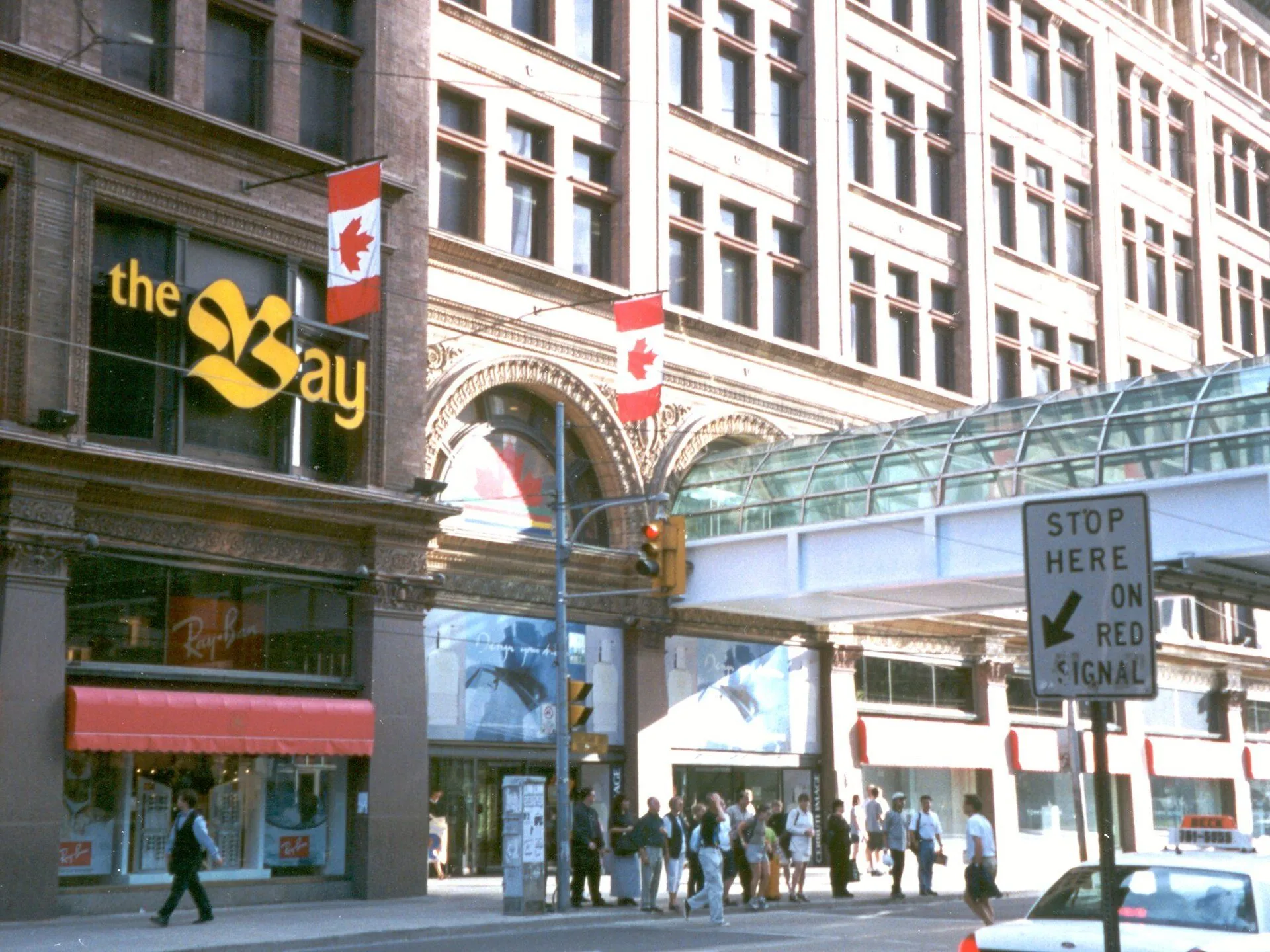
If you shopped downtown Toronto at any point in the 20th century, you probably knew the corner. Queen and Yonge had two giants, and Simpsons was the one with the polish: a stone landmark with a fashion salon for designer labels and, up on the eighth floor, a soaring Art Deco dining room where the chicken pot pie was practically a civic institution.
Then, in the summer of 1991, the name came off the building, and for more than three decades the corner belonged to the Bay. In the fall of 2025, after the Bay itself was gone, its signs came down, and there it was underneath: SIMPSONS, still in the stone.
The story
Robert Simpson didn't start in Toronto. From 1858 to 1871 he ran general merchandise businesses in Newmarket. In 1872 he opened a dry goods store at 184 Yonge Street. Timothy Eaton had opened his own store at 178 Yonge three years earlier, so the two names were bound together almost from the start.
In 1894 Simpson moved into a new six-storey building at the corner of Queen and Yonge. Then, in March 1895, a major fire destroyed it. Simpson rebuilt on the same spot and reopened in January 1896, the year the business became the Robert Simpson Company Limited. He didn't get to enjoy it long. Simpson died in 1897, and the company was sold to three Toronto businessmen.
Under its new owners the store kept growing. A large catalogue facility opened downtown in 1917, giving Simpsons a serious mail-order operation of its own. In 1925 the company took the name Simpsons, Limited. In 1929 a nine-storey Art Deco addition opened, and with it came the feature people still talk about most: the Arcadian Court.
Simpsons also courted fashion-minded shoppers. In 1937 the Queen Street store opened the St. Regis Room, a fashion department where clothing was shown selectively to clients and where, over the years, shoppers could find names like Christian Dior, Yves Saint Laurent, Oscar de la Renta and André Courrèges.
In 1952 came the deal that would reshape Canadian retail. Simpsons and the American giant Sears, Roebuck formed a joint venture, Simpsons-Sears. It came with a geographic rule: the new company wouldn't compete within 25 miles of established Simpsons stores. Simpsons-Sears grew into a major retailer in its own right, and eventually became Sears Canada.
At its peak, Simpsons stretched from Regina to Halifax, but most of its stores were in the Toronto and Montreal markets. The Montreal store had its own answer to the St. Regis Room, a high-fashion department called Salon Vendôme. Outside Toronto, Ontario shoppers knew Simpsons stores in cities including Ottawa, London, Kitchener, Kingston and Windsor, which helps explain why the name still rings a bell well beyond Queen and Yonge.
Why people remember it
Ask people about Simpsons and the conversation tends to drift upstairs, to the Arcadian Court. It opened on March 11, 1929, across the eighth and ninth floors, with 40-foot ceilings and tall windows. It could seat about a thousand people, which made it the largest dining room in Canada at the time. Lalique chandeliers hung from the ceiling until they were sold in 1968. The Toronto Symphony Orchestra made its first radio broadcast there in 1929.
The menu was famous for one thing above all. Simpsons' chicken pot pie stayed on the menu for decades, and in the early 1980s the kitchen was turning out roughly 1,500 portions a week. Not everything about the room aged well, though: the mezzanine was a men-only section for decades.
Simpsons also built a reputation for fashion and food, with the St. Regis Room and, after a later modernization, a gourmet food hall in the basement. The Arcadian Court competed with the Royal York and Eaton's Round Room as one of the places to be seen in Toronto, right through the Depression.
What happened?
The slow end of Simpsons began with a takeover. In late 1978 the Hudson's Bay Company made a bid for the company, and on December 28, 1978, it announced the bid had succeeded, in a deal worth $347 million.
Under the same owner, Simpsons and The Bay were now two department-store chains chasing the same shoppers. Stores started to drop away. Simpsons closed in Regina in 1981 and Ottawa in 1983. In 1986 its stores in London, Kitchener, Kingston and Windsor, along with operations in Nova Scotia, were converted to The Bay. The downtown Montreal store closed on January 28, 1989.
By 1991, with Canada in another recession and department stores under pressure from changing shopping habits and stiff competition, HBC decided that keeping Simpsons going as a separate banner cost too much. The company announced the end on June 5, 1991. On August 14, 1991, the eight Simpsons stores HBC kept were renamed The Bay. Six others went to Sears.
The flagship at Queen and Yonge carried on as The Bay's Queen Street store, and for a while it looked like it had a fresh future. In January 2014 HBC sold the building and an adjacent office tower to Cadillac Fairview for about $650 million, then leased the store back for at least 25 years. The deal tied the old Simpsons flagship to the neighbouring CF Toronto Eaton Centre, which had been built around Eaton's, its old rival. HBC also announced that a Saks Fifth Avenue store would take 150,000 square feet inside. The Arcadian Court lived on as well, reopening in May 2012 as an events venue run by Oliver & Bonacini, still serving its chicken pot pie.
Then the Bay itself ran out of road. Hudson's Bay closed its Queen Street store on June 1, 2025, with Saks going too, ending roughly 130 years of department-store retailing on the site.
What's there now?
The building still stands at 176 Yonge Street, a designated heritage building. As of the most recent reports we found, it's owned by Cadillac Fairview and no longer operates as a department store. Because Cadillac Fairview owns it, Retail Insider noted in April 2026, it sits outside the court-supervised sales of HBC's other big buildings.
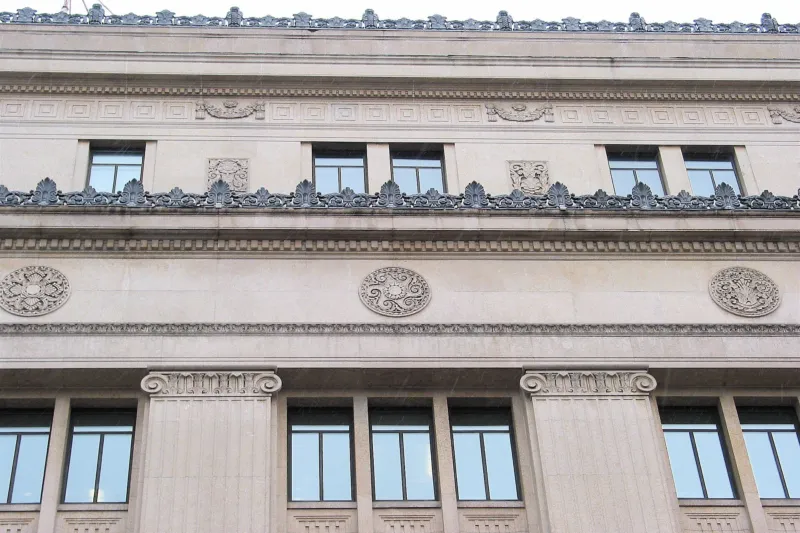
The most striking change is on the outside. As Cadillac Fairview began removing Hudson's Bay signage in the fall of 2025, the word SIMPSONS reappeared in the stone of the Queen Street facade. Retail Insider photographed it on October 12, 2025, and reported in August 2026 that the old lettering was still visible.
What comes next is less clear. In July 2025 Cadillac Fairview said it was evaluating ways to fill the space but hadn't made decisions, and by October 2025 it still hadn't announced plans. An idea to use the building as temporary space during renovations at Queen's Park was reportedly ruled out. In late 2025, Cadillac Fairview began leasing the building's display windows to outside brands, keeping the downtown holiday-window tradition going with a new twist.
Upstairs, the Arcadian Court has carried on without the store. In late September 2026, Oliver & Bonacini's website was still taking holiday-party bookings for its Arcadian venue, listed at the eighth floor of Simpson Tower, 401 Bay Street.
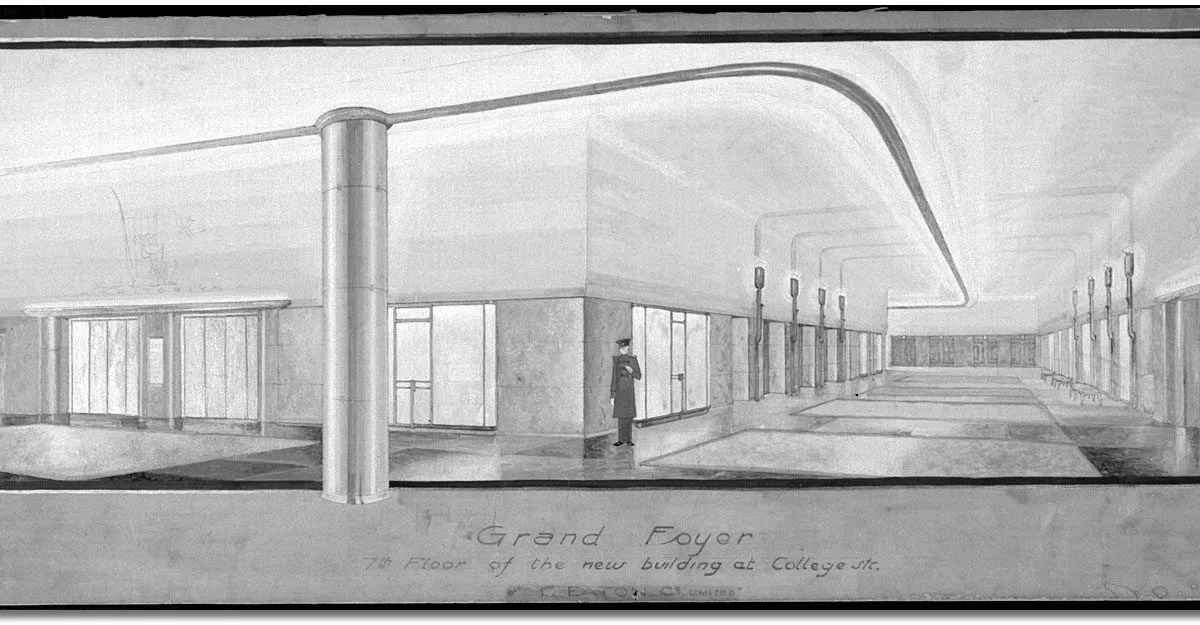
For more on what's become of Ontario's old department store buildings, including Eaton's College Street, see our Then & Now story.
Quick facts
- Founded: 1872, at 184 Yonge Street, Toronto
- Founder: Robert Simpson (died 1897)
- Queen and Yonge store: opened 1894; rebuilt after the March 1895 fire and reopened January 1896
- Arcadian Court: opened March 11, 1929
- Simpsons-Sears: formed 1952
- Hudson's Bay Company takeover announced: December 28, 1978
- Renamed The Bay: August 14, 1991
- Hudson's Bay Queen Street closed: June 1, 2025